

From Physical Essence: IPSOAR Brings You a Complete Guide to Understanding Memory Compiler Types and Selection
2026-06-23
As a core IP that accounts for 20%-60% of the total chip area in chip design, the selection of Memory Compiler directly determines the chip's area, performance, power consumption and tape-out cost. Since the 40nm process node, with the exponential improvement of chip integration, the categories of Memory Compilers have rapidly diversified, and products with different architectures, ports and memory cells show significant differences. Understanding their physical essence beyond superficial types to make the optimal selection has become core knowledge for chip design teams across the industry.
With 8 years of in-depth experience in Foundation IP R&D and mass production, Suzhou IPSOAR Microelectronics has built a full-process node product matrix covering Planar and FinFET processes. Based on the mission of coordinated industrial development, IPSOAR officially launched the "Foundation IP In-depth Usage Popularization Program" on its 8th anniversary. This article breaks down the classification logic, features and selection pitfalls of Memory Compilers from the physical layer, providing professional and practical technical references for the industry to help improve chip design efficiency.
1. Core Dimension 1: Port Architecture — Defining the Basic Working Mode of Memory
Port is the most essential classification basis for Memory Compilers. Different port configurations correspond to distinct clock mechanisms, read-write parallelism and Bit Cell structures, making it the primary judgment criterion for selection.
| Port Type | Clock Count | Read-Write Port | memory cell | Schematic Diagram of Memory Cell Structure | Core Physical Characteristics |
| Single Port (SP) | 1 | 1 rw | 6T | 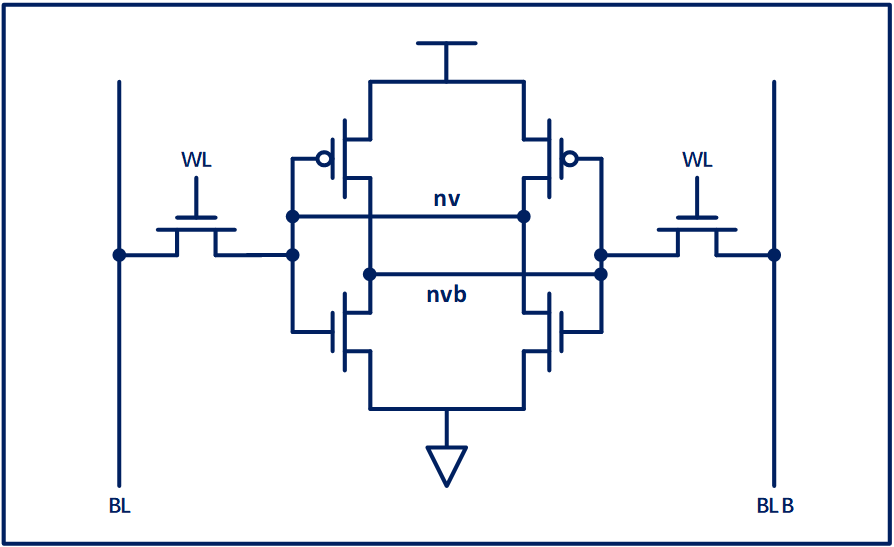
| Simplest structure, smallest area, lowest power consumption, supporting only read or write operations at the same moment |
| Two Port (2P) | 2 | 1 r + 1 w | 8T | 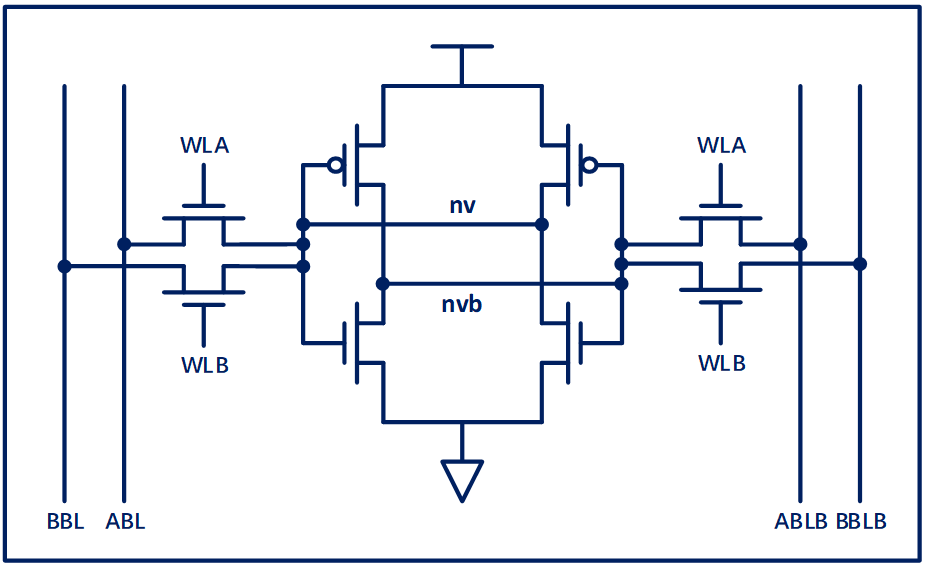 Or Or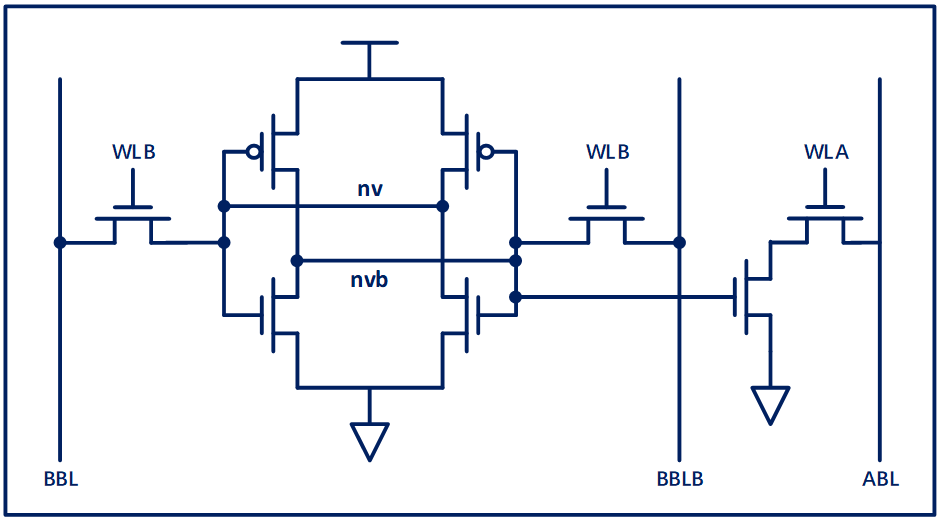 | Support simultaneous read-write parallel operations |
| Dual Port (DP) | 2 | 1 rw + 1rw | 8T | 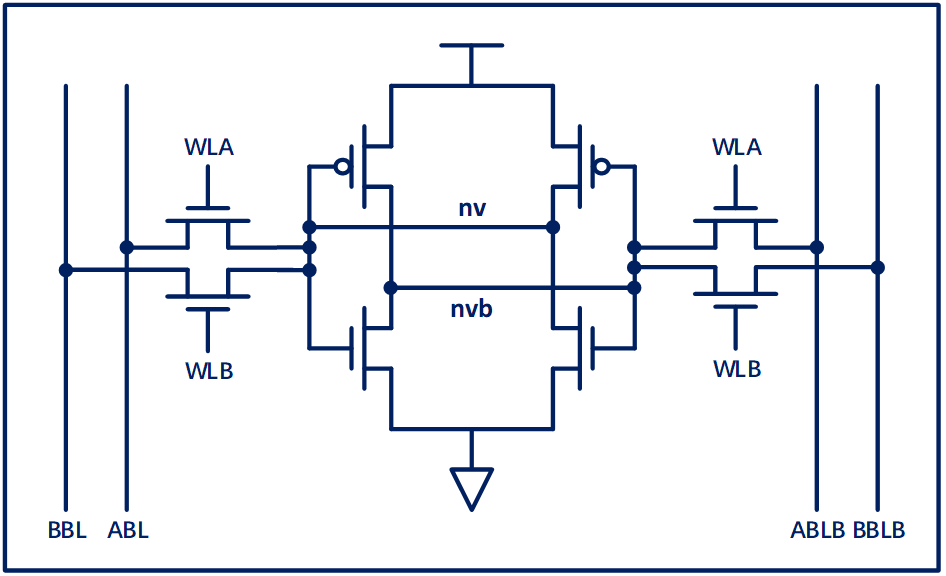 | Support bidirectional read-write parallel operations |
| Pseudo Two Port (UHD 2P) | 1 | 1 r + 1w | 6T | 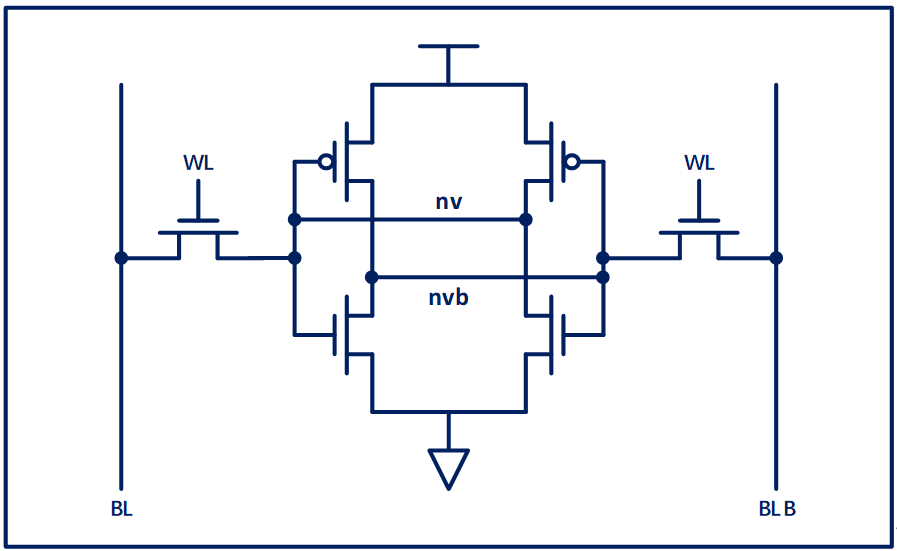 | Implement Two-Port functionality under a single clock with a smaller area |
| ROM | 1 | 1 r | 1T | 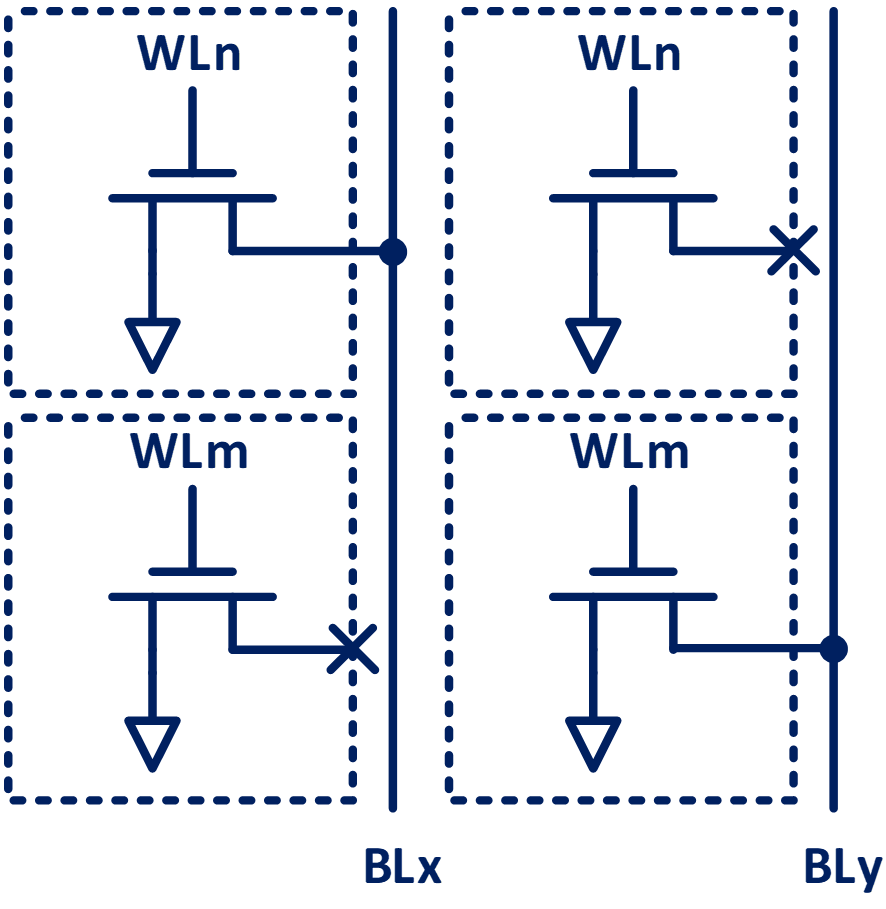 | Ultra-compact unit area, non-modifiable fixed data, highest reliability |
Core Conclusion: The number of ports directly determines the concurrency capability of the memory, and is positively correlated with area and power consumption. The pseudo two-port design performs read and write operations in a time-sharing manner internally under a single clock, enabling the reuse of 6T cells to achieve the optimal balance between functionality and cost.
2. Core Dimension 2: Architecture Type — Capacity Adaptation Logic of Register File and SRAM
Under the same port configuration, Register File and SRAM are the two mainstream architectures, and their core differences stem from their completely different order-of-magnitude capacity ranges.
| Architecture Type | Typical Capacity Range | Core Adaptation Features | Physical Essence Difference |
| Register File(RF) | from several dozen Kbit to several hundred Kbit | Remarkable area advantage in small-capacity scenarios | The design only covers the small-capacity range, with a simple circuit architecture and small circuit size, thus achieving a smaller area |
| SRAM | 512Kbit to several Mbit and above | Large-Capacity Scenario Solution | To support large-capacity design, the architecture needs to be compatible with large-capacity scenarios, and the circuit size also needs to be larger, resulting in a larger overall area |
Taking IPSOAR's 22nm process, 128Kbit Memory data as an example, the 1P RF is 13% smaller in area than the SP SRAM:
| Memory Type | Relative Area |
| 128K HD 1P RF | 1 (Baseline Value) |
| 128K HD SP SRAM | 1.13 |
Selection Tip: For small-capacity scenarios, prioritize Register File. It can save approximately 10%~20% of the chip area without affecting the digital design flow.
3. Core Dimension 3: Performance Grade — Design Priority Differences of HD/UHD/HS
The industry's widely used naming conventions HD (High Density), UHD/EHD (Ultra High Density), and HS (High Speed) are essentially design-oriented distinctions based on memory cell dimensions, corresponding to the two core demands of "area priority" and "speed priority" respectively.
| Performance Grade | Memory Cell Specification | Design Priority | Core Trade-off |
| UHD/EHD (Ultra High Density) | Small 6T cell (e.g., 22nm 114 size) | Extreme Area Optimization | Smallest area, slowest speed |
| HD(High Density) | Large 6T cell (e.g., 22nm 140 size) | Area-Speed Balance | Larger area, faster speed |
| HS(High Speed) | Large 6T cell | Extreme Speed Optimization | Largest area, fastest speed |
Taking IPSOAR's 22nm process, 512Kbit single-port product as an example, the quantitative comparison of area and timing is as follows:
| Memory Type | Relative Area | Relative Clock-to-Q Timing |
| UHD SP SRAM | 1 (Baseline Value) | 1.09 |
| HD SP SRAM | 1.22 | 1 (Baseline Value) |
Key Reminder: Some processes or vendors use HD/HS as their product series, while others use UHD/HD as their series.
4. Comprehensive Analysis of 22nm Process Memory Compiler Types
Based on the full range of IPSOAR's 22nm Memory Compiler types, the distinctions of each type are introduced as follows:
| MC Product Type | Memory Cell Specification | Read-Write Port Configuration | Core Features |
| UHD 1P RF | Small 6T (114) | 1 set of read-write multiplexed ports | Smallest area in small-capacity scenarios |
| UHD SP SRAM | Small 6T (114) | 1 set of read-write multiplexed ports | Optimal area in large-capacity scenarios |
| HD 1P RF | Large 6T (140) | 1 set of read-write multiplexed ports | Fastest speed in small-capacity scenarios |
| HD SP SRAM | Large 6T (140) | 1 set of read-write multiplexed ports | Faster speed in large-capacity scenarios |
| HD 2P RF | 8T (216) | 1 set of read + 1 set of write ports | Standard dual-port register file |
| HD DP SRAM | 8T (284) | 2 sets of read-write multiplexed ports | Concurrent read-write without conflict |
| UHD 2P SRAM | 6T (114) | Single clock: 1 set of read + 1 set of write ports | Single-clock dual-port, smaller area |
| HD Via ROM | 1T | Only 1 set of read ports | Lowest cost, highest reliability, ROM code modifiable by changing the Via mask layer |
For the high-demand specification of 22nm 16Kbit dual-port, a targeted comparison of area and timing differences is as follows:
| Memory Type | Relative Area | Relative Clock-to-Q Timing |
| HD 2P RF | 1(Baseline Value) | 1(Baseline Value) |
| UHD 2P SRAM | 0.55 | 1.19 |
Selection Conclusion: UHD 2P SRAM can save 45% of the area, but with a 20% increase in timing delay. It is suitable for designs that do not require extremely high speed but pursue ultimate area and cost optimization.
5. Pitfall Avoidance Guide: Common Industry Selection Misunderstandings and Professional Explanations
Based on usage feedback from serving over 100 chip design clients, IPSOAR has summarized the four most common selection pitfalls to help the industry avoid design rework and cost waste.
Misunderstanding 1: Single Port Memory only needs SRAM, not Register File (RF).
Professional Explanation: The two are fully compatible at the digital design interface level with no usage differences, but capacity is the core dividing point. For small capacities, Register File's area is 15%-25% smaller than SRAM of the same specification, with better timing. Prioritizing RF can directly reduce chip area and lower chip cost.
Misunderstanding 2: When timing is tight, simply replace the HD series with the HS series.
Professional Explanation: The HS series improves speed by selecting larger memory cell sizes and design optimizations, typically being 10%-30% faster than the HD series. However, attention must be paid to process cost differences: HS products using large Bit Cells may require confirmation with the wafer foundry regarding the need for 2 additional metal mask layers. Otherwise, overall manufacturing costs could increase by approximately 5%. Selection requires comprehensive consideration of timing margin, area constraints, and wafer cost.
Misunderstanding 3: When selecting Two Port memory, seeing HD 2P and UHD 2P but not knowing the difference.
Professional Explanation: In advanced processes, there are two types of Two Port Memory. Focus on two indicators when choosing: one is the number of clocks (if 2 clocks, it's standard Two Port; if 1 clock, it's Pseudo Two Port or UHD 2P); the other is the Bit cell (if it's an 8T bit cell, it's standard Two Port; if it's a 6T bit cell, it's Pseudo Two Port or UHD 2P).
Misunderstanding 4: Comparing Memory compilers from different companies, finding that Company A's SP memory area is smaller than Company B's, and thus choosing Company A's MC.
Professional Explanation: There are many types of SP memory, and naming conventions vary between companies (e.g., HD 1P RF/HD SP SRAM/UHD 1P RF/UHD SP SRAM/HS 1P RF/HS SP SRAM). When comparing, the first step is to check whether it is a register file or SRAM. The second step is to see which series (UHD/HD/HS) it belongs to—essentially, looking at the SRAM bit cell size is sufficient. The third step is to check the maximum supported capacity. If comparing only at medium capacity, Company A's area might be smaller than Company B's, but if Company A does not support large capacities while Company B does, then for larger capacities, Company B might only need one instance, whereas Company A requires multiple instances stitched together. In this case, Company B's MC might actually occupy less area on the chip than Company A's. Taking 22nm as an example:
| Company A MC | Max. density 512K | 512K Density area: 0.95 | 2M Density: 4x512K Instances stitched: 40.951.05 = 3.99 (the 1.05 coefficient accounts for the extra digital logic required for stitching) |
| Company B MC | Max density 2M | 512K Density area: 1 (Baseline Value) | 2M Instance: 3.75(6.5% area advantage) |
6. IPSOAR Microelectronics: Crafting High-Quality IP with Dedication, Fulfilling the Mission, Serving as a Knowledge Disseminator in the Foundation IP Industry
As a benchmark enterprise in China focused on Foundation IP R&D and mass production, Suzhou IPSOAR Microelectronics adheres to its original intention of quality, deeply optimizes PPA (Power, Performance, Area) around the characteristics of each process platform, and provides customers with highly competitive Foundation IP solutions. The company's independently developed Memory IP has served 14 Foundries, covering mainstream process nodes including 0.18um, 0.11um, 90nm, 55nm, 40nm, 28nm, 22nm, and FinFET. Process Features cover logic, HV, BCD, BSI, CIS, Eflash, Auto Grade 1, etc., widely used in consumer electronics, automotive electronics, artificial intelligence, industrial control, and other fields.
Zhou Bin, COO of IPSOAR, stated: "Memory Compiler IP is a crucial core module in ASIC/SoC chips. Due to its complex technical system, we have found in serving customers that many teams have insufficient understanding of the characteristics of various memory compilers, making it difficult to achieve reasonable selection and efficient application. As the local enterprise with the highest market share in the Foundry shelf Foundation IP market, IPSOAR Microelectronics is not only committed to providing customers with high-quality IP products but also hopes to help industry partners use the products well and maximize IP value. Therefore, we will also proactively shoulder the responsibility, act as the industry's Chief Knowledge Officer, and continuously output professional technical content."
【About IPSOAR】
Suzhou IPSoar Microelectronics Co., Ltd. (founded in 2018, headquartered in Suzhou) is a leading one-stop Foundation IP and Memory IP supplier in China, specializing in providing high-reliability, high-PPA competitive IP solutions. Its product line comprehensively covers core IPs such as Memory Compiler, Standard Cell Library, GPIO, TCAM Compiler, and OTP, supporting process nodes from 0.18μm to 22nm and advanced process platforms.
As an officially certified partner of 14 mainstream Foundries, the company not only ranks among the few manufacturers capable of providing full-chain IP support from mature processes to advanced nodes but has also been honored with outstanding supplier awards from multiple Foundries due to its stable delivery capabilities and high-quality Foundation IP products and services. In 40nm/28nm and advanced nodes, the PPA (Power/Performance/Area) metrics of its IP products are 5%-20% better than the industry average. The company focuses on the reliability of Foundation IP, relying on a comprehensive quality inspection process. It has now passed ISO 9001 quality system certification, ISO 27001 information security certification, and ISO 26262 functional safety management system ASIL D certification, ensuring a 100% tape-out success rate.